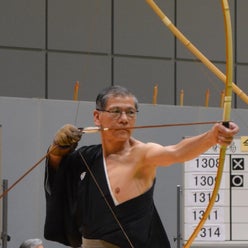
Kyudo Experience in Kyoto: Japanese Archery with a Master Sensei

This kyudo experience in Kyoto takes place in a sensei’s private dojo — and teaches you why Japanese archery has never been about hitting the target.

-Private Experience · Kyoto

Duration

~60 minutes

Group size

1–4 guests

From

¥6,000

Location

Kyoto

By Edgin Ticzon

Category: Cultural Experience · Kyoto

Reading time: 12 min

Most archery experiences hand you a bow, show you where to stand, and count how many arrows hit the mark. This kyudo experience in Kyoto is different. Here, you are taught to stand before you are taught to aim — and by the time you release your first arrow, the target is almost beside the point.

I

場所 · Basho

Where this kyudo experience in Kyoto takes place

At a Glance

The address is in Nakagyo Ward — the middle ward of a city that still largely navigates by its ancient grid. This is not the Kyoto of Fushimi Inari or Arashiyama. There are no souvenir lanes nearby, no tour buses idling at the corner. The streets here are quiet in the way that Kyoto’s residential neighbourhoods tend to be quiet: a bicycle leaning against a wall, the sound of something being cooked, a cat on a low tile roof. The practice space — からくり弓道体験場, Karakuri Kyudo Taiken-jo — belongs to the instructor himself. A sensei’s personal dojo carries a different quality from a rented studio or a hotel annex fitted out for tourists. The targets are real practice targets, used in regular training. The bow you will hold has been held many thousands of times before. The stillness in the room is not staged.
Yamaguchi Yoshiyuki, Kyoshi 6-dan instructor, kyudo experience Kyoto

Yamaguchi Yoshiyuki 山口喜由

Kyoshi 6-dan · Former President, Kyoto City Kyudo Association

60+ years of practice

Fushimi Technical H.S. (started)

Vice Chair, Kyoto Pref. Kyudo Federation

City Association President × 3 terms

Miyadaiku — shrine carpenter

Yamaguchi-sensei has been practising Kyudo for over sixty years, having taken it up as a student at Fushimi Technical High School in Kyoto. In that time, he served as Vice Chairman of the Kyoto Prefectural Kyudo Federation and as President of the Kyoto City Kyudo Association for three consecutive terms — six years in total, from 2008 to 2014. His rank is 教士六段 Kyoshi 6-dan: the 教士 Kyoshi title is not an extension of the 六段 rank but a separate certification, awarded by the All Japan Kyudo Federation to practitioners who demonstrate not only technical mastery but the capacity to embody and transmit the philosophy of the art. It is, in the most literal sense, a recognition that someone is qualified to teach — not merely to do.

Away from the dojo, Yamaguchi-sensei is a 宮大工 miyadaiku — a shrine carpenter, one of the specialist craftsmen responsible for building and restoring Japan’s Shinto shrines and Buddhist temples. The miyadaiku tradition demands an understanding of timber that borders on intimate: how each wood behaves across seasons, how joints must be cut to account for the movement of living material, how a building designed in the 8th century is maintained without the use of nails. The connection to Kyudo is not incidental. Both disciplines ask the practitioner to work with natural materials — bamboo, wood, hemp — while cultivating an internal quality of attention precise enough to detect imperfection before it becomes failure. In both, the hand is the instrument; the mind is the tool.

60+

Years of practice

教士

Kyoshi — instructor title

3

Terms as City Association President

Five minutes on foot from the dojo stands 壬生寺 Mibudera — one of Kyoto’s oldest Buddhist temples, founded in 991 during the Heian period. The Mibu district takes its name from an ancient term meaning “where water was born.” The Shinsengumi — the elite samurai police force of the late Edo period — trained on these streets. Martial discipline is not a novelty in this neighbourhood. It is part of the ground itself.

“In both Kyudo and shrine carpentry, the hand is the instrument. The mind is the tool.”

II

武道 · Budō

Kyudo, the way of the bow

The Japanese word 弓道 kyudo translates literally as “the way of the bow.” The suffix dō is the same character that appears in 柔道 judo, 剣道 kendo, 茶道 sado (the tea ceremony), and 書道 shodo (calligraphy). Its presence signals something important: this is not a sport in the Western sense, not primarily a contest of physical skill. It is a practice — a form of self-cultivation through a repeated, refined discipline.

Archery in Japan reaches back thousands of years: a warrior skill, a ritual offering, and a court art simultaneously. By the Edo period, with large-scale warfare replaced by a long peace, the martial arts turned inward. The external enemy was gone. The target became, in a meaningful sense, the self.

正射必中

Seisha Hicchū

An arrow shot with correct form will always find its mark. Accuracy is a consequence of correctness — not something pursued directly.

真善美

Shin Zen Bi

Truth, Goodness, Beauty — the three ideals the All Nippon Kyudo Federation identifies as the goals of practice. “Hitting the target” appears on no official list.

The All Japan Kyudo Federation states its goals in explicitly philosophical terms. There is no mention of winning. There is no mention of hitting the target. The prevailing philosophy holds that if the form is correct — if the posture, the breath, the mental state, and the release are all aligned — the arrow’s path is simply the natural consequence. Accuracy is the byproduct of correctness, not a goal in itself.

This is, for most guests joining a kyudo experience in Kyoto, the most disorienting and the most interesting discovery: Kyudo does not ask you to try harder. It asks you to try less — to release attachment to the outcome, and to give full attention to what is happening in the body, right now, in this breath, before the release.

III

礼法 · Reihō

The etiquette that is also the practice

In most disciplines, technique and etiquette are separate. In Kyudo, this distinction does not exist. 礼法 reihō — the code of formal conduct — is not a frame around the practice. It is the practice. Before a student in a traditional dojo ever draws a bow, weeks may be spent on nothing but standing, walking, and bowing. The logic is precise: the quality of attention you bring to the bow is revealed, first, in how you enter the room.

八節

Hassetsu — the eight stages of a single shot

Every arrow in Kyudo passes through eight precisely defined movements, each with a name, a prescribed form, and a mental state. The sequence takes far longer than it appears necessary — and that is the point.

#TERMWHAT HAPPENS
01 Ashibumi The feet are placed at a precise angle to the target line before anything else is done.Every element of the shot — posture, draw, release — rests on this foundation. A flawed stance cannot be corrected later. Yamaguchi-sensei will spend more time here than you expect.
02 Dōzukuri The body is aligned vertically: weight distributed evenly, spine extended, nothing forced, nothing collapsed.The body becomes a pillar — stable enough to hold a full draw without swaying. Most beginners discover here that their natural standing posture carries a great deal of hidden tension.
03 Yugamae The bow is raised and the arrow nocked. The hands assume their grip. The mind is asked to become still.This is the moment of commitment. The sequence that follows cannot be interrupted or restarted. Yugamae is where intention is set.
04 Uchiokoshi Both arms rise together in a single, unhurried movement until the bow is held above the head.The instruction given here is rarely "lift." It is closer to "float." The distinction — and the difficulty of making it felt rather than understood — is part of what the session teaches.
05 Hikiwake The bow is drawn open from the centre outward — both arms moving simultaneously, not one pulling against the other.The sensation is of expansion, not effort. Pulling feels like force; drawing correctly feels like opening. The bamboo bow is heavy. Getting this wrong is immediately apparent.
06 Kai The archer reaches full draw and holds — not waiting for the right moment to release, but remaining present within the draw itself.This is where the practice lives. Kai lasts longer than beginners expect. Some describe it as the longest moment. The arrow does not leave until something resolves — not a decision, but a readiness.
07 Hanare The arrow leaves the bow. In Kyudo, this is understood as something that happens — not something that is done.Not thrown — released. The distinction matters enormously in practice, even if it sounds like philosophy. A forced release is visible immediately; a natural one is not.
08 Zanshin The posture is held exactly as it was at the moment of release — arms extended, body open — while the arrow is in flight.The practice does not end at the moment of release. Zanshin — "remaining mind" — is the recognition that the quality of what preceded the shot is still visible in what follows it. The arrow tells the truth; so does the second after it leaves.
Of the eight stages, 残心 zanshin — “remaining mind” — most surprises first-time practitioners. After the arrow is released, the archer does not relax, does not look to see where it landed. The posture is held exactly as it was in the moment of release: arms extended, body open, attention complete. A practitioner who checks the target immediately has already revealed something about their state during the shot.

“The arrow tells the truth — but so does what happens in the second after it leaves.”

IV

流れ · Nagare

What to expect: how the experience runs

TIMEWHAT HAPPENSNOTES
0:00Welcome & introductionMeet Yamaguchi-sensei and your English-speaking guide at the dojo. The guide — sensei's own student — will accompany you throughout and interpret between English and Japanese. Brief orientation to the space and its equipment.
0:10Reihō — standing, entering, bowingBefore touching the bow, guests learn the basic postures and movements of the dojo: how to enter, stand, and address the equipment. More physical than expected, and more revealing.
0:20First contact with the equipmentSensei demonstrates the bow — its construction from bamboo and wood, the weight of the draw, the purpose of the glove (yugake). Guests handle the equipment for the first time under close guidance.
0:30Hassetsu — step by stepThe eight stages are taught one by one. Sensei guides each guest individually through stance, posture, raising, drawing, and the moment of kai. Hands-on correction throughout — expect to feel the difference between what you think you are doing and what the sensei observes.
0:45Live shootingGuests shoot at the target with live arrows. Each person shoots individually; the group watches. The sensei observes and adjusts. Whether the arrow hits the target or not tends, by this point, to matter less than expected.
0:55Closing reflectionA moment to ask questions and reflect. Sensei is generous with time here. The session ends with a final bow to the equipment — reihō, one last time.

What’s included: Kyoshi 6-dan certified instructor・Individual hands-on guidance throughout・English printed materials on Kyudo・All equipment provided・Live arrow shooting at target・Beginner-friendly, no experience needed

V

感想 · Guest voices

What people say about this kyudo experience in Kyoto

United States · Solo traveller

“I came expecting a sport. What I got was something much closer to meditation. The sensei didn’t speak much English but he didn’t need to — every adjustment he made to my posture communicated exactly what words couldn’t. I stood still for what felt like a long time before releasing my first arrow. When it finally left, I barely noticed where it landed.”

Germany · Couple

“What surprised me most was how much of the session happened before we touched the bow. We spent the first twenty minutes just learning how to stand and move in the space. By the time I drew for the first time, I felt genuinely prepared — not rushed through to the ‘fun part.’ The sensei clearly cares about this being done properly.”

Australia · Family group

“Yamaguchi-sensei has a warmth that comes through immediately, even without a shared language. He laughed when I got something wrong and made me feel like making mistakes was the whole point. I left understanding something about patience that I hadn’t expected to find in an archery class.”

Book this experience

Practical information and pricing

1 to 5 Guests

¥7,700 per person

よくある質問 · Before you book your kyudo experience in Kyoto

Frequently asked questions

None at all. This kyudo experience in Kyoto is specifically designed for beginners, and the entire curriculum assumes no prior knowledge. Experienced archers are also welcome, though they will find the approach significantly different from Western archery — the point of the session is Kyudo’s philosophy, not technical accuracy.

Yes. Yamaguchi-sensei’s student — a fluent English speaker — accompanies every session as your guide and interpreter. They will explain the philosophy and technique of Kyudo in English throughout, and translate directly between you and sensei during hands-on instruction. You have the full benefit of Yamaguchi-sensei’s sixty years of practice, communicated clearly in your own language.


Comfortable clothing that allows free movement of the arms and shoulders. Avoid very loose sleeves, which can catch the bowstring on release. Flat, closed-toe shoes are recommended. Traditional Kyudo attire (hakama) is not required for this introductory session.

Guests must be at least 12 years old to participate. Younger teenagers are welcome; sensei is experienced working with younger students and adjusts the pace accordingly. Children often take to the meditative aspects of Kyudo more readily than adults.

壬生寺 Mibudera Temple is a five-minute walk from the dojo — one of Kyoto’s oldest temples (founded 991), free to enter the main grounds, and rarely crowded. The Kyoto Seishu Netsuke Art Museum is also nearby. Both make for a natural extension of a morning in Mibu.

Year-round · Shared · 1–5 guests

Available whenever you are ready

Availability is limited. Enquire to check your preferred dates — we typically respond within 24 hours.