Authentic Experience · Inuyama, Aichi

The Recipe That Was Never Written Down: Japan's Last Nindōshu Brewery in Inuyama

In a merchant house below Inuyama Castle, one family has made the same medicinal liqueur since 1597. The method has never been recorded. It has been spoken, once a generation, to a single child — and this generation has decided that is no longer safe enough.

By Rhojani Francisco

Category: Craft & Culture

Reading time: 11 min

There is a recipe in Japan that has never existed on paper.

Not in a safe, not in a family ledger, not in a notebook in a drawer. For more than four hundred years the method for making nindōshu has been spoken aloud by one person to one person, once a generation, and then held in memory. The current head of the Kojima family — the fifteenth generation, by the family’s own count — is the only person alive who knows the whole of it.

It is an extraordinary thing to stand in a room and understand that the complete instructions for something four centuries old are in Suzuki Mariko‘s memory, and nowhere else at all.

Table of Contents

What Nindōshu Actually Is

Nindōshu (忍冬酒) is a medicinal liqueur made in Inuyama, Aichi Prefecture, from Japanese honeysuckle steeped with rice. It is not sake, although it comes from a brewing house and is often shelved beside it. It is yakuyōshu — a medicinal drink — and it was valued for centuries as a tonic rather than as something to pour at dinner.

The plant is suikazura, Lonicera japonica, which grows wild in the hills around Inuyama Castle and appears in traditional Chinese and Japanese herbal medicine. The drink is thick, sweet, and unmistakably herbal. The sweetness is not added; no sugar goes in. It comes entirely from the saccharification of the rice, the same conversion of starch into sugar that underlies sake brewing, taken in a different direction. Locally it is drunk over ice, cut with soda water, or in winter with hot water. It is not warmed like sake.

If you want a shorthand: something between a herbal liqueur and a very old idea of medicine, poured from a ceramic bottle.
A drink named for surviving the winter

The name is the best part. The characters 忍冬 read as nindō and mean, literally, enduring winter — the old name for honeysuckle, given because the plant keeps its leaves through the cold when almost everything around it does not.

In 1619 the monk Takuan Sōhō passed through Inuyama and drank the Kojima family’s nindōshu. He praised it, and left behind a poem that turned on that name: the winter-enduring plant, the cold passed through, the plum blossom that opens afterwards, and a person likened to all three. The hanging scroll is still in the house. It is four hundred years old and it is, essentially, a very good review.

A Samurai, a Kindness, and a Change of Trade

The origin story is one the family tells rather than one the archives can settle, and it is worth telling as such.

As the Kojima family tells it, a Kojima man — a samurai from the Yosaka quarter of Inuyama’s castle town — was sent to the Korean peninsula in the 1590s as part of Toyotomi Hideyoshi’s military campaigns. During the expedition he showed mercy to someone on the other side. In gratitude, that person taught him how to make nindoshu, a drink then known at the Korean court.

He came home, gave up being a samurai, became a merchant, and in 1597 began brewing on the site the family still occupies. Kojima Jōzō dates its founding to that year.

The details vary depending on who is telling it. City and encyclopaedic sources name the first-generation Kojima Hikosuke and say he brought a brewer back with him from the peninsula in 1592. Local Inuyama accounts name the second-generation Yajizaemon and describe Korean prisoners he spared. The family’s own telling, given in person, is of an injured person helped and a method given in thanks. The shape is consistent across all three: an act of mercy in a brutal war, repaid with a recipe, carried home by a man who then put down his swords.

For context on the date: 1597 is three years before the Battle of Sekigahara and six years before Tokugawa Ieyasu was appointed shogun and the Edo period began. This is a business older than the Tokugawa era itself.

The Drink the Shogun Was Sent

Nindōshu did not stay a local curiosity for long. It was prized as a drink of longevity, and Tokugawa Ieyasu is said to have been fond of it.

That reputation gave it a particular function. Inuyama Castle was held by the Naruse clan, senior retainers of the Owari branch of the Tokugawa. The Naruse presented Kojima nindōshu upward to the shogunal house, and sent it outward as a gift to daimyō across the country — the seventeenth-century ancestor of ochūgen and oseibo, the mid-year and year-end gifts that still move through Japanese offices every summer and December. A daimyō receiving a bottle understood exactly what it meant. It could not be bought casually. It came from one house, in one town, and its arrival said something about the relationship.

The Kojima family was rewarded accordingly. Though merchants, they were granted myōji taitō — the right to a surname and to carry swords, ordinarily reserved for the samurai class. They served as town elders of the castle town. Their estate ran to roughly a thousand tsubo, around 3,300 square metres, with a street frontage of some sixty metres.

What the ledgers show

There is a document from 1837, the Owari domain’s register of brewing rice, that puts the scale beyond anecdote. Six brewers in Inuyama were licensed by the domain that year. The Kojima house was working 1,350 koku of rice. The next largest, the Inukai family, was at 1,200. Everyone else fell between roughly ten and a hundred.

By the late Edo period the Kojima family was not a boutique operation. It was the largest brewing house in town by a wide margin.

Isshi Sōden: One Child, Every Generation, for Four Centuries

The rule that governs the recipe has a name: isshi sōden (一子相伝) — transmission to a single child. Paired with it is mongai fushutsu, meaning it does not go beyond the gate.

In practice this means the method has never been written, never taught to an employee, never divided between siblings, and never explained to a partner. One child per generation is told. That child eventually tells one child. Fifteen times, by the family’s count, this has happened, and the chain has not broken.

Plenty of Japanese crafts describe themselves as isshi sōden. Very few can point to four centuries of it with the house, the name, and the product all still in place.

It is worth pausing on the arithmetic, because it is severe. Fifteen unbroken transmissions. Fifteen occasions on which a person had to be willing to learn, and be there to be taught, and live long enough to teach in turn. Through the Meiji Restoration, which dissolved the domain system that had been the drink’s entire market. Through a war during which rice was rationed and brewing was very nearly impossible, and during which the family kept production going anyway.

Why Inuyama Is the Only Place Left


Inuyama

Nindōshu was never made only here. It was produced in Hamamatsu, in what is now Shizuoka Prefecture, and in Kishū, present-day Wakayama, where the Kitamura family made a version for the Kii branch of the Tokugawa. The historical record suggests the Kishū style was quite different: sharper, more karakuchi, closer in character to shōchū than to the sweet liqueur made in Inuyama.

Both lines ended. The upheavals of the Meiji Restoration, and later the Second World War, closed them.

Today Kojima Jōzō in Inuyama is the only producer of nindōshu with an unbroken line back to the Edo period. The qualifier matters and the family is careful with it: in 1997 a group of liquor retailers in Hamamatsu revived a nindōshu of their own, and it is sold there now. It is a modern reformulation rather than a continuation. What Inuyama has is not exclusivity so much as continuity — the same house, the same method, no interruption.

Inside the Kura: Buried Jars and a House That Cannot Be Altered

Walking into the brewery is not what most people expect from four hundred years of history.

There is no visitor centre, no interpretive signage, no restored showpiece. There are heavy timber posts blackened with age, earthen plaster walls, a staircase worn narrow by use. There are also fluorescent strip lights, sheets of corrugated metal where a wall needed patching, plastic crates stacked against a post, tanks sheeted over with plastic. Sunflowers grow up against the outside wall in summer.

It is a working building, and it looks like one. Nothing has been arranged for visitors, which is exactly why it is worth seeing. The historic equipment is not on display — it is simply still there, left where it stopped being useful. Among it is the old rice press, a beautiful piece of machinery no longer in service.

The detail that explains the most about pre-industrial brewing is a traditional ceramic jar, set against the modern stainless tanks in use today. The jar looks smaller than it is, and the reason is that it was never meant to be seen whole. It was buried — set deep into the earthen floor, in contact with the ground along its full depth. It was not moved. It did not need to be. The earth around it held a steady temperature through summer heat and winter cold, which is precisely what a slow fermentation wants and precisely what nobody could otherwise provide in 1700. Refrigeration is about a century old. This solution is far older and required no power at all.

The family plans to build a glazed viewing room inside the kura so that visitors can see into the preserved spaces without disturbing the conditions inside them.

Seven registered structures

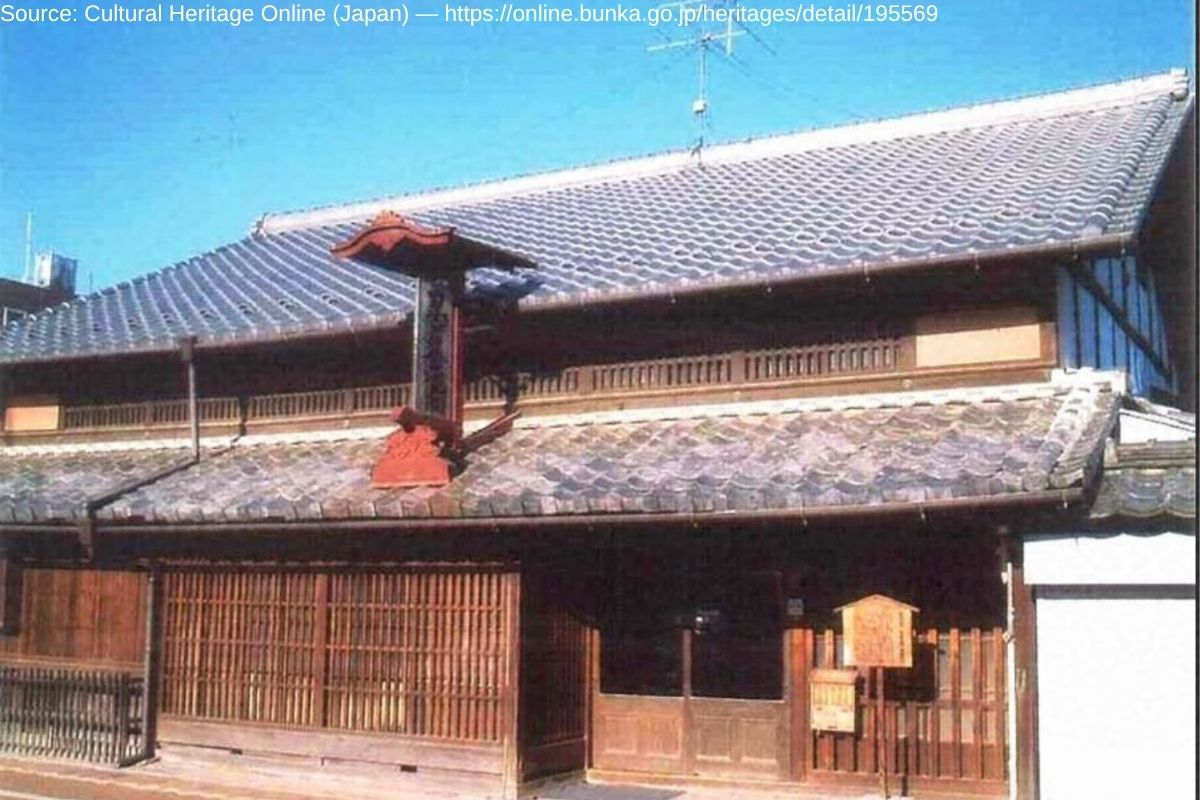
Seven structures of the Kojima property are listed by the national government as Registered Tangible Cultural Properties: the main house, the formal reception rooms, the south storehouse, the north brewing storehouse and north storehouse, the west brewing storehouse and preparation room, the tea-reception building, and the roofed wall along the street. All seven were registered on 9 February 2005.

A Registered Tangible Cultural Property is Japan’s designation for buildings judged important to the nation’s heritage. In plain terms: the building itself is protected historical evidence, and it cannot be casually altered or demolished. What you are standing in is not a reconstruction and not a museum set.

The individual dates are their own kind of record. The reception rooms went up in 1847, in the late Edo period. The main house was rebuilt around 1897, its street face latticed across almost the whole of both floors. The government’s own description calls it indispensable to the historic landscape of the district.

The Decision to Write It Down

Here is where the story turns.

Someone in the family did the obvious arithmetic and did not look away from the result: if the only complete copy of the method is in one person’s memory, then four hundred and thirty years can end in an afternoon. Not through neglect, or market forces, or war — through an ordinary accident.

So the family has formed a company with new partners, and has begun the work of documenting what 鈴木満理子 Suzuki Mariko carries. What was never written down is now being written down, deliberately, for the first time since 1597.

This is a more interesting decision than it first appears, because secrecy was never incidental to nindōshu. It was the point. Mongai fushutsu is why the recipe survived competitors, retainers, and four centuries of people who would have liked to have it. Choosing to record it means accepting that the thing which protected the tradition has become the thing most likely to end it.

The current generation has been making other quiet corrections in the same spirit. The rice, over the centuries, drifted — as local farming declined, the family bought where it could, including from Mie Prefecture, based on availability and price. Suzuki-san has taken the sourcing back to rice grown in Inuyama itself, and describes the method more broadly as returned to how it was done before. At the same time the brewery has released a fruit-infused nindōshu, a new expression alongside a recipe that has not moved.

Restoration and experiment at once, from a family that has had four hundred years to think about the difference.

Planning a Visit to Inuyama

Getting there

Inuyama sits at the northern edge of Aichi Prefecture, on the Kiso River, facing Gifu across the water. Meitetsu Inuyama Station is roughly 25 to 30 minutes from Meitetsu Nagoya Station by limited express, which makes this one of the easiest substantial half-days available from the city. The castle town is a short walk from the station, and Kojima Jōzō stands at 633 Inuyama Higashi-koken, one street back from the main Honmachi-dōri thoroughfare.

What else is worth your time

Inuyama Castle. The keep is a National Treasure, one of only twelve original castle keeps surviving in Japan, and it looks out over the Kiso River. It was privately owned by the Naruse family — the same lords who sent nindōshu to the shogun — until 2004, which is a genuinely unusual footnote for a National Treasure.

The castle town itself. Honmachi-dōri runs from the town’s entrance up toward the castle, lined with machiya townhouses, and it is walkable end to end in an afternoon.

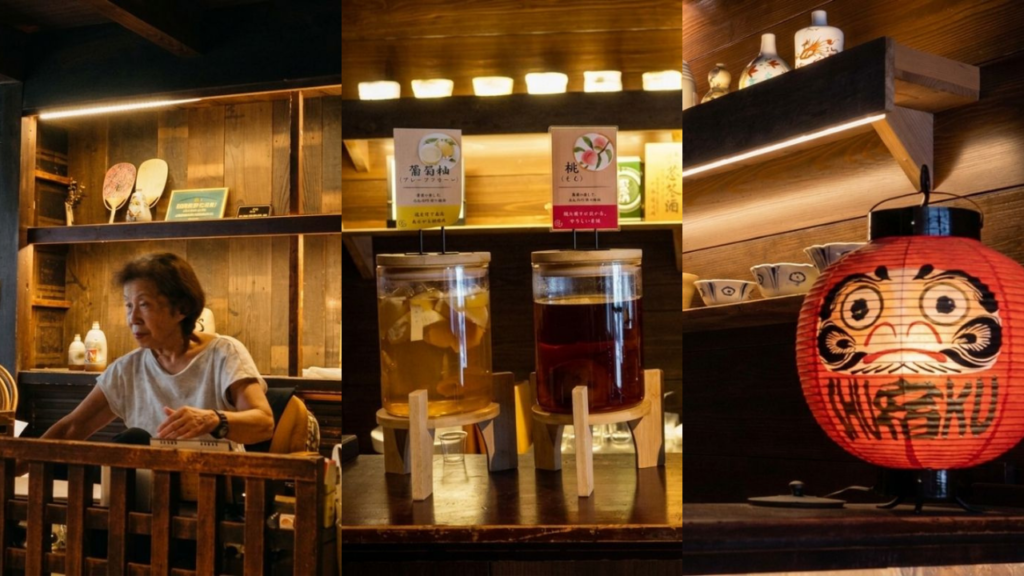
Staying inside the story. In 2025 part of the Kojima residence itself opened as Shuku, a small inn within the registered structures, alongside a second registered building elsewhere in the town. Guests are received in the old brewing shop’s counter room and served a non-alcoholic drink based on nindōshu. There is a Japanese restaurant on site. For a traveller who wants the whole day to hold together, sleeping in the same protected building where the recipe has lived since 1597 is not a bad way to do it.

Timing. The Inuyama Festival takes place on the first weekend of April. Thirteen three-tiered floats carrying karakuri puppets are drawn through the castle town, a tradition dating to 1635 and inscribed by UNESCO in 2016. The town is busy accordingly, and accommodation books out well ahead.

Experience It With Honey J

Honey J is developing a private visit to Kojima Jōzō with the family, for small numbers — a tour of the kura, a tasting, and the hand-written label session with one bottle to take and one laid down in the cellar. 

If you would like to build a day in Inuyama around it, or fold it into a wider journey through Aichi and Gifu, our team arranges private itineraries across the region. We are a government-licensed Class 1 travel agency based in Nagoya, thirty minutes from the brewery gate, and this is our own backyard.

Enquire about a private visit → https://www.honeyj-tours.com/experiences/inuyama-nindoshu-brewery-tour/

Frequently asked questions

Nindōshu is a Japanese medicinal liqueur made from suikazura (Japanese honeysuckle, Lonicera japonica) steeped with rice. It has been produced in Inuyama, Aichi Prefecture, by the Kojima family since 1597.

No. It is classified as a liqueur, not sake, though it is made in a brewing house and uses rice. It is served over ice, with soda water, or with hot water in winter — not warmed like sake.

Thick, sweet, and herbal. The sweetness comes entirely from the saccharification of rice; no sugar is added.

Nindōshu was also produced historically in Hamamatsu and in Kishū (present-day Wakayama). Both lines ended with the upheavals of the Meiji Restoration and the Second World War. Kojima Jōzō in Inuyama is the only producer with an unbroken line back to the Edo period.

No. Kojima Jōzō is a working brewery inside a Registered Tangible Cultural Property and is not open to the public. Visits are arranged in advance through operators working directly with the family. Honey J runs a 90-minute Inuyama Sake Brewery Tour for one to six guests, with an English interpreter, tasting, and bottle sealing and labelling.

Meitetsu Inuyama Station is roughly 25–30 minutes from Meitetsu Nagoya Station by limited express on the Meitetsu Inuyama Line. The castle town is a short walk from the station.

It is an official Japanese government designation for buildings of particular importance to the nation’s cultural heritage. Registered structures are protected and cannot be freely altered or demolished. Seven structures of the Kojima residence were registered on 9 February 2005.

Sources

Descriptions of the Kojima family’s history, brewing practice, and current preservation work are drawn from Honey J’s interview with the fifteenth-generation head of the Kojima family at Kojima Jōzō, Inuyama.

Historical detail is drawn from Inuyama City’s Historic Townscape Maintenance and Improvement Plan (2nd Period), Inuyama City Board of Education, Historic Townscape Division, and the 1837 Owari Province Brewing Rice Register cited therein.

Book this experience

Ninety minutes, four centuries

1–6 GUESTS

The Experience

¥22,000

Per Person

Ninety minutes at Kojima Jozo with an English interpreter. Tour the cellars, taste four to five pours including unfiltered Nindoshu, then seal and hand-label two bottles on the brewery’s cast-iron press. One comes home with you the same day; the second is laid down in the cellar under your name.

7+ Guests

Larger groups

Enquire

By arrangement

The brewery receives a maximum of six guests at a time. For larger parties we arrange consecutive sessions or a private booking with the family. Send us your dates and group size and we will put it together.

Year-round · Private / Shared

Available whenever you are ready

Availability is limited. Enquire to check your preferred dates — we typically respond within 24 hours.