-Cultural Immersion · Aichi

The Way of Bow and Horse: A Samurai Afternoon in Inuyama

Long before the sword became the samurai’s symbol, a warrior was measured by how he rode. On this private afternoon of samurai horse riding in Inuyama, you meet a horse on foot, ride it in hakama or armor, and end the afternoon around a charcoal fire and a bowl of tea.

Duration

150-210 min

Group size

2-4 guests

From

¥37,500

Location

Inuyama, Aichi

By Rhojani Francisco

Category: Craft & Culture

Reading time: 15 min

Table of Contents

Before the Sword, the Saddle

Ask most visitors to picture a samurai and they will picture a sword. The early warriors would not have recognized that image.

When the warrior class first rose to power in the Heian and Kamakura periods, it fought from horseback. Above all, its weapon was the bow, not the blade. The ideal it lived by had a name: kyūba no michi, “the way of bow and horse.”

Warriors judged a man by whether he could stay in the saddle, guide his horse with his knees, and loose an arrow at full gallop.

That ideal has not entirely disappeared. At shrines across Japan, mounted archers in hunting dress still ride yabusame as a ritual offering, firing at wooden targets as the horse runs past. Most people watch it once, from behind a rope.

This afternoon, however, is different. Nobody fires an arrow, and nobody gallops. But you dress as the riders did, you learn to approach a horse the way a rider must, and you sit in the saddle yourself. As a result, it is the closest most travelers will ever come to the oldest meaning of the word samurai.

A Town That Kept Its History Close

Inuyama sits on the Kiso River, about 25 minutes by train from Nagoya. Its castle keep is one of only five in Japan designated a National Treasure, and one of the oldest original keeps still standing. The streets below it still follow the layout of the old castle town.

In addition, tea has deep roots here. In the garden of Urakuen, next to the castle, stands Jo-an, a tea house built by Oda Urakusai, younger brother of the warlord Oda Nobunaga and a tea master in his own right. Notably, it is one of only three tea houses in Japan designated a National Treasure.

The estate where this afternoon takes place, Irori Sabo Kusu Komaya, is in Kurisu, a quiet rural corner of the city a short taxi ride from Inuyama Station. You will not pass a souvenir shop on the way in. There is a wooden sign painted with a leaping horse, a fenced riding yard, and a room with old timber beams built around a sunken hearth.

Dressing the Part

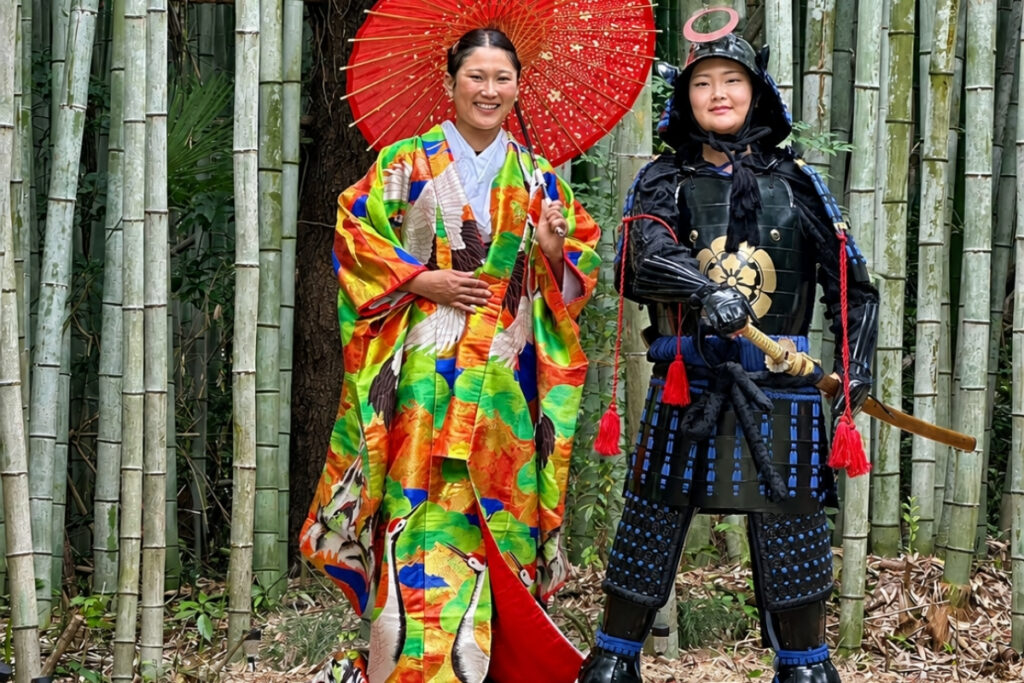
The afternoon begins indoors, with clothes. You choose between two ways of dressing. Each carries its own history.

袴

Hakama

Wide and pleated, these trousers are tied at the waist over a kimono. By the Heian period (794–1185) they were already part of formal dress at the imperial court, and the samurai class later made them its everyday formal wear. For a warrior, the cut mattered. Umanori-bakama, “horse-riding hakama,” are divided into two legs so the wearer can sit astride a saddle, while the undivided andon-bakama came into wide use much later.

The pleats are folded with care: five at the front and two at the back, often said to stand for the virtues a samurai was expected to keep. Even so, hakama never fully left Japanese life. They are still worn today in kyudo archery, kendo and aikido, at formal tea gatherings, and by many young women at their university graduation.
甲
冑

Samourai Armor

The first great samurai armor, the ō-yoroi of the Heian and Kamakura periods, was built for a mounted archer. Its boxy body hung from the shoulders, and its broad shoulder plates acted as shields, because both of the rider’s hands were busy with the bow and reins. It was made of hundreds of small iron and leather scales called kozane, lacquered against Japan’s humid climate and laced together row by row with braided silk cord.

When firearms reached Japan in 1543, armor changed again. The tōsei gusoku, or “modern armor,” of the Warring States period used solid plates to stop a musket ball. Later, in the long peace of the Edo period, armor moved from the battlefield to the family alcove, where it was kept as an heirloom. Even today, families display miniature armor today for Children’s Day in May, as a wish for their sons’ strength.

The staff dress you. Naturally, this takes time, and that is part of the point. You do not pull armor on like a costume; the staff tie it on in layers, each cord pulled and knotted in order. By the time the last piece is fastened, you move differently: straighter in the back, turning your whole body instead of just your head.

Moreover, the attire fits a range of builds, including taller guests. As a guide, kimono fit up to about 190 cm in height, and the armor up to about 180 cm and 80 kg.

Samurai Horse Riding in Inuyama: A History in the Saddle

Horses came to Japan from the Asian mainland around the fourth and fifth centuries. Clay horse figures and bronze bridle fittings buried in the great tombs of the Kofun period show how quickly they became a mark of power. Simply put, whoever had horses ruled the land around them.

That said, the horses the samurai rode were not the tall animals of a modern racecourse. Japan’s native breeds were small and sturdy, often around 130 cm at the shoulder, bred for mountain paths and rice-field roads rather than speed on open plains. The rider sat high in a deep wooden saddle, and his stirrups were open, slipper-shaped abumi that let him stand and turn his body to draw the bow.

The Three Arts of Mounted Archery

Over time, riding became a discipline in its own right. The warrior houses developed three mounted archery arts, known together as the kisha mitsumono: yabusame, shooting at fixed targets at a gallop; kasagake, shooting at distant targets; and inuoumono, a now-vanished contest of shooting within an enclosure. In 1187, Minamoto no Yoritomo, founder of the first shogunate, had yabusame performed at Tsurugaoka Hachimangū in Kamakura, and the Ogasawara and Takeda schools still preserve it today.

The Groom at the Horse's Head

A samurai of rank rarely led his own horse on the ground. A groom, the kuchitori, walked at the horse’s head and held the bridle, in processions and on the road. When you see the estate’s staff walking beside your horse, you are looking at a very old arrangement.

Eventually, in the peaceful Edo period, horsemanship, bajutsu, became an art taught in formal schools, and a daimyo’s horses were part of his public image. After 1868, Japan imported Western horses and crossbred its herds for the army, and the old native breeds nearly disappeared. Eight survive today, kept by local preservation societies.

At Kusu Komaya, both chapters of that story stand in the same place. The estate keeps Japanese-breed horses alongside Western breeds, and your host can explain how they differ, and why the samurai’s horse looked nothing like a modern racehorse.

Meeting the Horse on Foot

You do not climb straight on.

First you stand beside the horse on the ground. The staff show you how to approach it, where to stand, how to hold the lead, and how a horse reads the person next to it. For example, a horse notices hesitation. It notices a sudden movement and a raised voice. In other words, most of what a rider communicates happens before they ever sit down.

A warrior’s horse was not a vehicle; it was a partner he depended on, and the bond started on the ground.

Then you ride. Each guest takes a turn of about 20 minutes in the saddle, guided by the estate’s staff. No riding experience is needed, and the others in your party can watch and take photographs while they wait their turn.

Riders must weigh under 80 kg, and children can ride from elementary-school age. Guests who are pregnant or have a health condition cannot take part in the riding. A companion who does not want to ride is welcome to join the rest of the afternoon.

The Fire at the Heart of the House

People in Japan have cooked around an open fire inside their homes for thousands of years. The pit dwellings of the Jōmon period were built around a hearth in the middle of the floor. As houses rose onto raised wooden floors, the fire stayed where it was, set into a square box of earth and ash in the boards. This is the irori, the sunken hearth.

For most of Japanese history, the irori did almost everything. It cooked the food, heated the room, lit the house after dark and dried wet clothes. Meanwhile, its smoke rose into the thatched roof, where it dried the straw and kept insects away, helping the roof last for decades. Above the fire hung the jizai-kagi, an adjustable hook for lowering a pot or kettle toward the flames. It was often fixed with a carved wooden fish, a charm against fire, because fish live in water.

Who Sat Where

The hearth also set the order of the household. Each side had a name and an owner. The head of the house sat at the yokoza, the seat of honor facing the room. His wife sat at the kakaza, nearest the kitchen, where she could tend the fire and serve. Guests took the kyakuza. The lowest seat, the kijiri, was at the end where the firewood went in. A visitor could read a family’s whole structure just by watching where everyone sat.

However, the irori began to disappear in the 1950s and 1960s, as gas stoves, electric heaters and modern kitchens reached rural Japan. Today it survives mainly in preserved farmhouses, mountain inns and a handful of restaurants.

Lunch at the Hearth

Here, the estate cooks lunch the same way. Charcoal glows in the center of the hearth, and skewers are set upright in the ash around it, leaning toward the heat. Seasonal side dishes, rice and hot tea arrive at the wooden table that rings the hearth.

In short, there is no kitchen door between you and the food. You see it cook, you smell the charcoal, and you eat sitting around the same fire. It is a slow meal, and it is meant to be.

With seven days’ notice, the kitchen can prepare vegetarian and halal meals. The kitchen cannot accommodate food allergies.

One Time, One Meeting

The afternoon ends in a tatami room. Two suits of armor stand against the wall, and a scroll hangs in the alcove. The noise of the yard is gone.

Yet the samurai class did not only ride and fight. From the sixteenth century onward, many warlords studied the way of tea as seriously as they studied war, and some of the most famous tea masters served them directly. Oda Urakusai, who built Jo-an a short drive from here, was both a warrior and a tea master.

The tea ceremony has a phrase for what it asks of you: ichigo ichie, “one time, one meeting.” This gathering, with these people, in this season, will never happen in quite the same way again, so host and guest treat it with full attention.

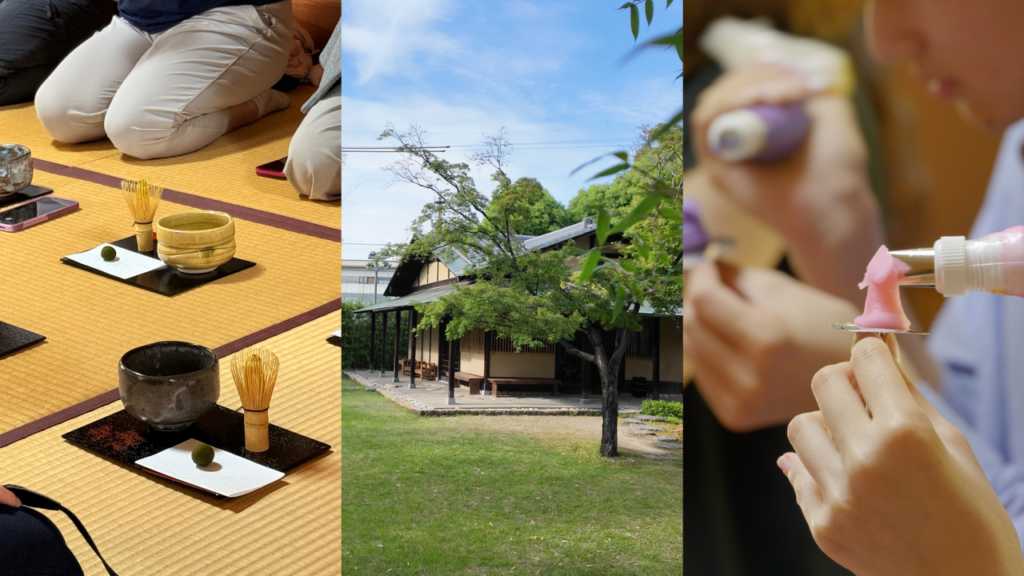
You whisk your own bowl of matcha and eat a seasonal sweet. Your host explains what each movement means and why the bowl is turned before you drink. Also, chair seating is available for guests who cannot kneel on tatami.

Why This Isn't a Costume Photo Shoot One

Admittedly, there are many places in Japan where you can put on armor for twenty minutes and have your photo taken. But this is not one of them.

  • It is private. Only your party is there, two to four guests, with no other groups sharing the yard, the hearth or the tea room.
  • It is one continuous afternoon. You dress, ride, eat and drink tea in one place, in an order that makes sense: the warrior’s day, then the warrior’s rest.
  • Someone explains it. An English-speaking host stays with you the entire time and explains what each piece of armor is for, why the hearth mattered, and what the tea ceremony asks of you.
  • The horse is the point. Few samurai experiences in Japan include riding, and we found no other in the Nagoya area.

Who This Is For

This afternoon suits couples and families who want one day in Japan to feel unlike the rest of the trip. It suits guests who have already seen the castles and temples and want to do something with their hands. It also suits small groups of friends traveling between Tokyo and Kyoto who are looking for a reason to stop in Nagoya.

On the other hand, it is less suited to guests who want a fast-paced day. The afternoon is slow on purpose.

Book this experience

Inuyama Heritage Immersion: Horsemanship, Irori Hearth & Tea Ceremony

2 Guests

¥37,500

Total ¥75,000

3 Guests

¥31,700

Total ¥95,100

4 Guests

¥28,750

Total ¥115,000

Included: attire styling (kimono and hakama, or samurai armor), ground work and a guided ride, irori lunch, private tea ceremony with a seasonal sweet, and an English-speaking host throughout.

Not included: transportation to and from Inuyama, and personal expenses.

Schedule: Tuesdays, Thursdays, Saturdays and Sundays, one morning and one afternoon session. Closed December 29 to January 5. Please book at least seven days ahead.

Have a group of 5 or more?

よくある質問 · Before you book

Frequently asked questions

No. You learn to approach and handle the horse on the ground first, and the staff guide the horse throughout your ride.

Riders must weigh under 80 kg. Children can ride from elementary-school age. Guests who are pregnant or have a health condition cannot take part in the riding.

Yes. A companion who does not want to ride can join the attire, the irori lunch and the tea ceremony. Please contact us for the rate.

Riding does not take place in the rain. The estate decides by 5 p.m. the day before, and the ride is replaced with waraji straw sandal making indoors.

Vegetarian and halal meals are available with seven days’ notice. The kitchen cannot accommodate food allergies.

Comfortable pants you can ride in, and clean socks for the tatami rooms and dining area.

Yes. Chair seating is available.

Take the Meitetsu line from Nagoya to Inuyama Station (about 25 minutes), then a taxi of about 10 to 12 minutes. Free parking is available if you are driving.

Free cancellation up to 4 days before. 50% from 3 days to 1 day before. 100% on the day.

Year-round · Private / Shared

Available whenever you are ready

Availability is limited. Enquire to check your preferred dates — we typically respond within 24 hours.