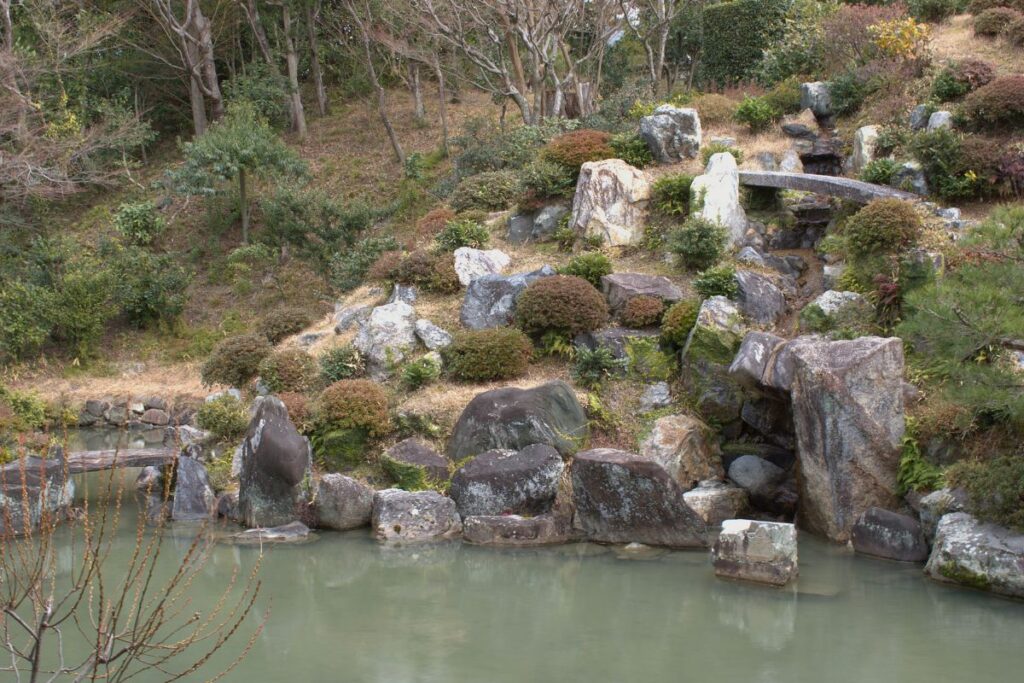
Large stones symbolise mountains and hills. Smaller rocks and gravel line ponds and streams.
-Garden Design · Kyoto
How to Read a Japanese Garden: Three Gardens in Kyoto with a Specialist
A shogun’s garden, a statesman’s villa and a temple garden linked to Sen no Rikyū. Three hours in Kyoto with a licensed guide who is also a certified garden designer.
Duration
180 min
Group size
2-5 guests
From
¥15,700
Location
Kyoto
Table of Contents
Three Gardens, Three Centuries of Kyoto
On 21 April 1903, four men climbed to the second floor of a small Western-style house in eastern Kyoto: Yamagata Aritomo, Itō Hirobumi, Katsura Tarō and Komura Jutarō. At the time, tension with Russia was rising, and historians see the meeting they held there as shaping Japan’s later diplomatic policy in East Asia. Today the house still stands, its upstairs room kept as it looked that day. It sits in the garden of Murin-an, one of the three gardens on this tour.
One garden was made for a shogun who never came. Another hosted the meeting where Japan’s leaders set their course toward Russia.
Honey J’s Private Japanese Gardens Tour with Specialist is a three-hour walk through Konchi-in, Murin-an and Chishaku-in, for two to five guests. Throughout, a licensed guide who is also a certified garden designer leads it. Between them, the three gardens span nearly three centuries, from the early Edo period to the Meiji era, and the tour ends with drinks and sweets at the garden café in Murin-an.
Most visitors see Kyoto’s gardens as scenery. This tour, however, treats them as design and as history. The guide covers the elements of each garden and the story behind them: the stones, the plants, the water, the use of space, the viewpoints and the symbolism. It is a private tour, and the page rates it beginner level.
Konchi-in: the garden built for a shogun
Konchi-in is a temple within Nanzen-ji. The temple began in Kitayama in the early fifteenth century and later moved to its present site in 1605. Its abbot, Sūden, had served Tokugawa Ieyasu first as a warrior and later as a priestly adviser, and it was Sūden who asked for the garden.
Kobori Enshū designed it. Tradition credits Enshū with many Kyoto gardens, but at Konchi-in documents support the attribution. Work began in 1611 and ended by 1632. Sadly, Sūden died in Edo in 1633 without ever seeing the finished garden in Kyoto.
A garden for the shogunate
The garden was meant to welcome the third Tokugawa shogun, Iemitsu, but the visit never happened. A memorial shrine to Ieyasu stood just east of the garden, visible from the main hall’s veranda, and garden and shrine together declared the temple’s ties to the shogunate.
In addition, the temple’s tea ceremony room ranks among the three major teahouses of Kyoto, and the grounds also hold a pond of koi and turtles.
Above all, what you see in the main garden is a dry landscape garden south of the abbot’s quarters. A tortoise island stands to the left of a central worshipping stone and a crane island to the right, both traditional symbols of long life, which is why it is sometimes called Tsurukame no Niwa, the Garden of Crane and Tortoise. Central stones evoke Hōrai, the mountain islands of the Daoist immortals. Today the garden holds national designation as a Special Place of Scenic Beauty.
Murin-an: a statesman's villa and a new kind of garden
Yamagata Aritomo, a Meiji-era soldier and statesman, built a private residence near Nanzen-ji in 1894. Then, between 1894 and 1896, Ogawa Jihei VII created the garden. Also known as Ueji, he was the leading Kyoto landscape architect of the Meiji and Taishō periods.
Together, owner and designer broke with convention. Instead of classic elements such as ponds and moss, they chose flowing streams and lawns. The water arrives from the Lake Biwa Canal, which opened nearby in 1890, while the lawn centres on the “borrowed” landscape of the Higashiyama Mountains. A monument in the garden records Yamagata’s vision in his poems.
Murin-an covers about 3,000 square metres. It became a Place of Scenic Beauty in 1951, and Kyoto City owns it today. Finally, its garden café is in the main house, and this is where the tour ends.
Chishaku-in: Mount Lu and Rikyū's favourite
Chishaku-in, established in 1601, is a temple of the Chizan branch of Shingon Buddhism in Higashiyama Ward. However, it is best known for its paintings by the Hasegawa school, now National Treasures. They originally decorated the guest hall of another temple, Shōun-ji, and came to Chishaku-in afterwards. Fires in the Edo and Shōwa periods and theft in the Meiji period took much of the set, so what survives is all the more precious.
The paintings date from the Azuchi-Momoyama period (1568–1603). The Hasegawa Tōhaku school painted Maple Tree and other sliding-door panels. Tōhaku’s son Kyūzō painted Cherry Blossoms, a National Treasure, when he was around 25. He died the year after he finished it. Today the temple stores and preserves the paintings.
The garden lies directly behind the lecture hall. It imitates the landscape around Mount Lu (Lushan) in central China: a hill planted with flowering shrubs and set with granite stones, surrounded by a pond of a distinctive greenish-white colour. You view it from a slightly raised veranda. According to tradition, the tea master Sen no Rikyū (1522–1591) particularly loved this garden.
Why Kyoto's Gardens Reward Explanation
Many principles of the Japanese garden were largely set in the Heian period (794–1185), when the capital stood at Kyoto and gardens were central to aristocratic life. No Heian garden survives in its original form.
The oldest manual of garden-making comes from that era. The Sakuteiki (“Records of Garden Making”), written in the mid-to-late eleventh century and attributed to Tachibana no Toshitsuna, is described as most likely the oldest garden-planning text in the world. It treats stone placement as central: the phrase ishi wo tateru koto, “the act of standing up stones”, came to mean garden-making as a whole.
Heian layouts also followed feng shui principles. A stream entered from the northeast and left to the southwest, which matches the natural flow of water across the Kyoto plain.
From Heian ponds to Muromachi stones
Later periods added their own forms. In the Muromachi period (1336–1573), small scenic gardens became typical. A text attributed to the priest Zōen analyses garden stones in detail, giving them symbolic meanings and evocative names. Many of these gardens stand in Zen temples, although one source cautions against reading them as direct expressions of Zen thought.
Gardens also change. Most have been restored, and as that source puts it, “every garden is, by its very nature, a work eternally in progress.” That is one reason an explanation on site helps: what you see today is not always what a text from the eleventh century describes.
What the Tour Teaches You to Read
The tour page lists six things the guide covers: stones, plants, water, space, viewpoints and symbolism. Here is what each means, according to Japan-guide.com’s overview of garden elements.
石
Stones
水
Water
Ponds often represent real or mythical lakes or seas. In dry gardens, raked gravel and sand stand in for water.
島
Islands
Islands may represent real islands or carry religious symbolism, as turtle and crane islands do for longevity and health.
草
木
Plants
Maples and cherry trees are chosen for seasonal appeal, while pines, bamboo and plum trees are valued for winter beauty.
道
Paths and viewpoints
Strolling gardens use circular paths that guide visitors to controlled views. Winding paths separate areas, so each one can be contemplated individually. Large man-made hills, especially in Edo-period strolling gardens, may represent mountains and offer viewpoints.
借
景
Borrowed scenery
The Japanese term is shakkei. It brings outside mountains or castles into the garden’s design.
灯
籠
Lanterns and basins
Stone lanterns stand on islands, at the ends of peninsulas or near significant buildings. Stone water basins, called tsukubai, were used for ritual cleansing before tea ceremonies. The two are often paired in tea gardens.
Three kinds of garden
Dry gardens are composed entirely of stones, with gravel and sand replacing water.
Pond and strolling gardens use water for boating and for viewing from pavilions or shorelines, where aristocrats once held poetry and moon-viewing parties. Strolling gardens add circular paths and often large hills.
Tea gardens pair a stone lantern with a water basin as a basic component.
What to Look For in Each Garden
Each of the three gardens answers a different question, which is why seeing them together with one guide makes sense. Here is a short field guide, built from what is documented about each garden.
鶴
亀
At Konchi-in, look for the two islands
Stand where the abbot’s quarters face the garden. Find the central worshipping stone first, then the tortoise island to its left and the crane island to its right. Both are symbols of long life. Ask yourself why a garden made for a shogun’s visit would speak of longevity, and then remember that a shrine to Ieyasu stood just to the east.
流
れ
At Murin-an, follow the water
Most older Kyoto gardens hold still water in a pond. Murin-an’s water moves. It enters from the Lake Biwa Canal and runs across the garden as a stream. Follow it with your eyes, then lift them to the Higashiyama Mountains beyond the lawn. The garden was designed so that the hills outside feel like part of it. That is borrowed scenery at work, and here it is the centre of the whole composition.
廬
山
At Chishaku-in, picture a mountain in China
From the raised veranda, the hill of shrubs and granite stones in front of you is meant to call up the landscape around Mount Lu in central China. The pond that wraps around it completes the picture. This is a garden that asks for imagination: a small space standing in for a famous landscape far away.
時
代
Across all three, notice the change
Put the three side by side and you can see how ideas shifted. Konchi-in is an early Edo dry garden of stones and symbols. Murin-an, made almost three centuries later, swaps ponds and moss for streams and lawns. Chishaku-in, tied by tradition to Sen no Rikyū, sits between them in spirit, a garden meant to be viewed quietly from a building. Your guide can show you how the same basic elements, stone, water, plants and view, are used in very different ways.
Your Guide: Ayumi Ikushima
Ayumi (Murin) Ikushima leads the tour. Honey J’s guide page lists her as a “Garden Designer & Cultural Interpreter” and as a nationally accredited guide. Her specialties are Japanese gardens, garden design, ikebana and the cultural arts.
She lived in Europe for several years, which the guide page says gives her a cross-cultural perspective on Japanese aesthetics and philosophy. For a tour about how gardens are designed, that matters: she explains them as someone who designs gardens as well as someone who guides visitors through them.
Why This Isn't Just a Garden Visit
- It is private. The tour is for two to five participants, with your own guide.
- Someone explains it. The guide covers the elements and the history of each garden.
- It ends with a pause. The tour concludes with drinks and sweets at the garden café in Murin-an.
- It is for beginners. The page rates it beginner level, with an easy difficulty.
Who this is for
The tour suits small private groups of two to five. Guests must be 16 or older, and the guide speaks English.
Where it fits in a Kyoto trip
Chishaku-in is in Higashiyama Ward, and Konchi-in and Murin-an are in the Nanzen-ji area of Sakyō Ward. Higashiyama also holds Maruyama Park and our seated archery experience. For a wider plan, see our private full-day Kyoto tour or the Uji tea culture ride by Brompton.
Book this experience
Kyoto Gardens Tour: Konchi-in, Murin-an & Chishaku-in
PRIVATE TOUR · 2–5 GUESTS
¥15,700
From, per person
Included: a private tour with a licensed guide who is also a certified garden designer, guidance through Konchi-in, Murin-an and Chishaku-in, and sweets and a drink at the garden café in Murin-an.
Not included: transportation to and from the meeting point, and personal expenses.
Schedule: 180 minutes. The tour starts at the Stamp Booth at the entrance of Chishaku-in, Higashiyama Ward. Please book at least one week in advance.
HAVE A GROUP OF MORE THAN 5?
よくある質問 · Before you book
Frequently asked questions
How long is the Japanese gardens tour?
The tour runs for 180 minutes, which is three hours. It visits three gardens in Kyoto and ends with drinks and sweets at the garden café in Murin-an.
Which gardens does the tour visit?
The tour visits Konchi-in, Murin-an and Chishaku-in.
What happened at Murin-an in 1903?
On 21 April 1903, Yamagata Aritomo, Itō Hirobumi, Katsura Tarō and Komura Jutarō met on the second floor of Murin-an’s Western-style house as tension with Russia rose. The Murin-an Conference is seen as shaping Japan’s later diplomatic policy in East Asia.
Who designed the garden at Konchi-in?
Kobori Enshū designed the dry landscape garden at Konchi-in, and documents support the attribution. Work began in 1611 and was finished by 1632.
Who leads the tour?
Ayumi Ikushima, a licensed guide and certified garden designer, leads the tour in English.
Is the tour private, and how many people can join?
It is a private tour for two to five participants.
What is the minimum age?
The minimum age is 16.
Where does the tour start?
You meet your guide at the Stamp Booth at the entrance of Chishaku-in, in Higashikawaracho, Higashiyama Ward, Kyoto. The exact location is sent after you book, and the nearest stop is the Higashiyama Nanajo bus stop.
What is included in the price?
The price includes a private tour, garden expert guidance, insights into Japanese gardens, and sweets and a drink at the garden café in Murin-an.
What do the stones in a Japanese garden represent?
Large stones symbolise mountains and hills. Smaller rocks and gravel line ponds and streams, and in dry gardens raked gravel and sand stand in for water.
What is a dry garden?
A dry garden is composed entirely of stones. Gravel and sand take the place of water.
What is borrowed scenery?
Borrowed scenery, or shakkei, brings outside mountains or castles into a garden’s design.
CREDENTIAL LINE AND SOURCES
Honey J Travel is a government-licensed Class 1 Travel Agency (Licence No. 2149) headquartered in Nagoya.
Sources
- Garden Elements, Japan-guide.com
- Origins, The Japanese Gardens, Bowdoin College
- Sakuteiki, Wikipedia
- Garden at Konchi-in, Japanese Garden Dictionary (Nara National Research Institute for Cultural Properties)
- Konchi-in, The Japanese Garden, Bowdoin College
- Konchi-in, Japan National Tourism Organization
- Murin-an Garden, Murin-an official site
- Western-style House, Murin-an official site
- Murin-an, The Japanese Garden, Bowdoin College
- Chishaku-in, Wikipedia
- Chishakuin treasure exhibition, Chisan official site
- The Garden of Chishakuin, Japan Tourism Agency
- Chishakuin paintings, Japan Tourism Agency (PDF)
- Our Trusted Guides, Honey J Tours
Year-round · Private / Shared
Available whenever you are ready
Availability is limited. Enquire to check your preferred dates — we typically respond within 24 hours.